A field content program without a specific owner starts with energy and fades away over time. Before you add contributors, decide who owns the role, because this is a headcount decision as much as it is a strategic one.
Field and employee content programs rarely fail because the idea to have one was wrong. The reason they fail is because ownership was unclear or labeled as “a team effort.”
The pattern of programs fading into ambiguity is often familiar: a launch, robust enthusiasm, strong early submissions. Then one week slips. Then another. Within a couple of weeks to a quarter, the cadence your brand needs to sustain the program simply stops.
The social team always looks like the natural owner, since they already handle content. But before the program lands there by default, it needs a named individual with a real role and decision rights to adequately sustain the effort in a meaningful way.
The owner of a field program has a specific job:
Looking at the scope, it is clear that ownership of the decentralized content program has the potential to be a full role versus an additional side task. Where it sits can depend on your organization structure, including how large your organization and field team are, and what role each existing department plays within the organization. It can live with social, with brand, with field operations, or as a dedicated hire. In recent months, I’ve seen postings for roles at the director level with ownership of the distributed content team as a primary responsibility in healthcare and wellness brands. It’s worth asking which team in your organization would be best suited for this responsibility long term, and who on that team is your point person steering the ship.
I often hear marketing leadership default to social media simply absorbing this, since they are already doing content. I understand the instinct. But, a field content program is ongoing work layered on top of the calendar your social team already runs for campaigns and brand content.
If social owns it, get clear on how this content is going to be leveraged on top of the existing calendar. Also, is there bandwidth to take on something additional even if it fuels the variety available used for content? Because more content means more to manage, analyze, respond to, and measure. Eventually, something has to give. So, they either need more headcount, delegate an existing responsibility to another resource such as an agency partner, or our favorite option, establish strong systems to keep the team in running shape while adding this flow into the mix. Building smart workflows, intake forms with minimal required fields, equipped with automation and AI that can surface highlights from raw footage, so the owner's time goes to the judgment calls where they can affect outcomes instead of performing as an administrator.
At TGI Fridays, I personally owned the Social Instigators program that folded under social media, while also working closely in partnership with our field marketing team. Bi-weekly briefs went out to our creator contributors that were recruited during the inventory exercise we discussed last week. We also allowed space for opportunistic, in-the-moment content to be captured, too. Editing and color grading were centralized under a resource that sat on my social media team, which kept the queue visible and the feeds full of authentic, in-restaurant content.
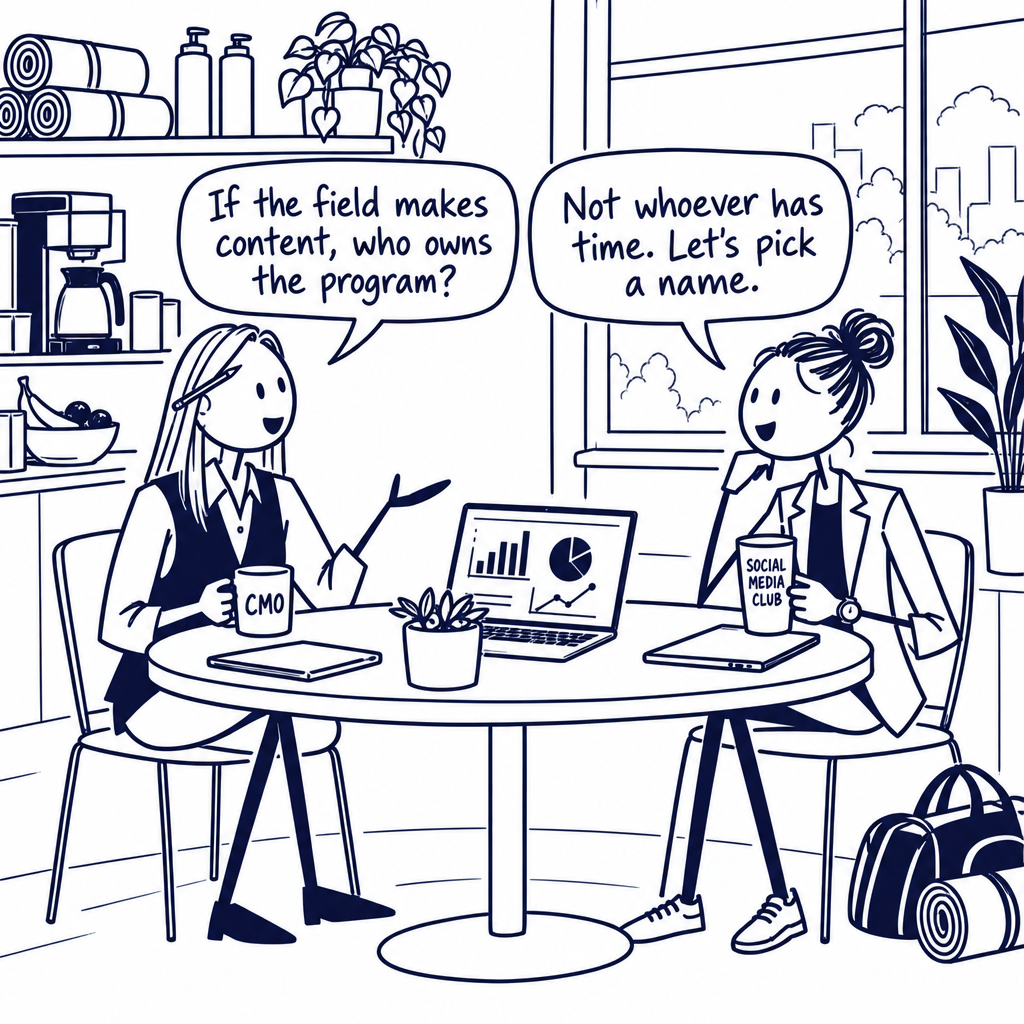
If we asked our field teams to create content, who would own the program?
Follow it with: Is there space for this or would we need to make room? This opens a real conversation about bandwidth, trade-offs and cross-functional partnerships, rather than putting your Head of Social on the spot.
This week's video walks through where the owner role can sit and what the first few weeks of the job look like. Watch here:
The CMO 5-Minute Briefing
A short, actionable briefing for marketing executives: what's shifting in social, why it impacts your bottom line, and one precise question to bring to your next 1:1 with your Head of Social.
One email a week. Unsubscribe any time.